
TechCrunch is Turning their Boston and SF Conferences into Deal Rooms

You heard that events are “where deals happen”; the truth is, they can only help if you show up ready to raise funds, not as an interloper.
TechCrunch isn’t being coy about what Founder Summit in Boston and Disrupt 2026 in San Francisco are meant to be. According to TechCrunch, both of these events are more than startup launchpads, they’re growth accelerators. As they promote on their website, attending these events will allow founders to “dive into sessions on scaling, sales, and leadership, and connect with the investors and tech experts who can help take your business to the next level.”
For many founders, these events are fundraising matchmaking opportunities providing direct access to 1,000+ founders and investors in Boston and 10,000 in San Francisco. Both events offer the opportunity to build relationships with VCs and other startup investors, solicit their backing, and even close deals. These are not generic presentation-based conferences, they’re structured marketplaces for attention, capital, and feedback. If you are pre‑seed to Series A, you’re not buying content; you are buying your way into a curated room where your peers, your competitors, and your potential investors are there for meanningful action.
What this Actually Changes for You
First, it changes how you should think about “pipeline”. If TechCrunch can reliably pull 1,000+ founders and investors into Founder Summit, plus thousands more to Disrupt, then for three or four days your outbound efforts and serendipity rate spike. In practice, that means a well‑run Founder Summit week can do the work of three months of cold outreach, provided you show up with a short list and a plan.
Second, it changes your benchmark. Walking into Disrupt or Founder Summit gives you a brutally honest snapshot of what “good” looks like this year: which AI and SaaS narratives are overplayed, how polished other teams’ GTM stories are, what traction investors now consider “standard” performance at your stage. You’ll see other companies in your niche on stage, in the expo, and in side events; that alone can sharpen your positioning faster than another week fiddling with your landing page copy.
Third, it changes the kind of investor conversations you have. At these events, you are not walking into cold rooms; you are walking into a context where investors are explicitly there to find deals, benchmark the market, and feed their own “fear of missing out”. Even “no’s” are useful because you can get a variety of useful feedback about why your current narrative may not be cutting it.
How to make these events actually worth the money
If you decide to go, you can’t treat these events like a conference; you have to treat them like “live” campaigning.
Pick one primary goal before you buy a ticket: fill your seed or bridge round, pressure‑test your competitive moat and narrative, or recruit a key hire. If your goal is “network”, you will drift. Map the attendee lists as they’re published; TechCrunch tends to highlight which investors and sponsors are involved, and they push exhibit options that can make sense if you already have some traction. Use that to build a ranked list of people you want to meet.
Next, anchor your week around making things happen, not just informal meetings. Have a crisp one‑pager for investors, a short video or demo you can show or send on the spot, and a specific “ask” for each conversation. If you’re raising, that might be: “We are opening a $1.5M seed with $600K soft‑circled; here is our traction and why this opportunity in AI infra is durable.” If you are pre‑PMF, it might be: “We are validating two segments; here is what we know so far; here is the decision we need to make in the next 60 days.”
Finally, treat the event as the start of the work, not the work itself. The follow‑up sequences you run in the two weeks after Founder Summit or Disrupt will determine 80 percent of the value you get. Block time on your calendar now for the days after the event for follow-up; you’ll need it.
When you should skip it
Of course, there are trade‑offs. Tickets, travel, and time away from customers are real costs. If you are burning hot, still untangling your core value prop, and don’t have even the beginnings of a repeatable user acquisition channel, a big‑ticket event can easily become an expensive distraction.
In that case, you might be better off listening to the “Build Mode” and “Equity” episodes TechCrunch publishes around the same time; those are full of tactical conversations with founders on hiring, lean teams, AI layers, and fundraising dynamics, and they cost you nothing but attention. You can still ride the information wave without flying to Boston or San Francisco.
If, on the other hand, you have a live product, a positive market signal, and a clear story, TechCrunch’s Founder Summit and Disrupt weeks are exactly what they are sold as: temporary, dense deal rooms. The question is not whether they are worth it in the abstract; the question is whether you’re ready to treat them as a campaign, not a field trip.
Other Fundraising Events Around the World
There other events like these TechCrunch events in the U.S. and around the world. Below are several events that, like TechCrunch Founder Summit and Disrupt, are explicitly designed as deal rooms: curated access to founders and investors who are actively building, backing, and closing startup funding opportunities.
Startup Grind Global Conference (US)
Startup Grind Global Conference in Silicon Valley is built around one goal: compress years of fundraising, hiring, and learning into 48 hours for early‑stage teams. The organizers highlight “12K minutes of 1:1 time with investors and mentors” and note that they scheduled over 400 investment meetings for exhibiting startups last year, with the top 100 exhibitors having raised more than $1.5B since 2020. If you are pre‑seed to Series A, this is very similar in spirit to Founder Summit: you apply to exhibit, then use the conference app and curated meetings to stack as many investor and partner conversations as you can in two days.
Slush (Europe)
Slush in Helsinki bills itself as “the world’s most founder‑focused startup event”, and it generally lives up to that tagline. It began as a 250‑person gathering and has grown into a tightly curated summit of European startups, global investors, and top operators, emphasizing high‑signal matchmaking rather than generic expo traffic. Slush is particularly powerful if you’re targeting European capital or customers; investors and founders treat it as a yearly checkpoint for meeting new companies, announcing rounds, and running focused side‑events.
Web Summit (Europe)
Web Summit in Lisbon is one of the largest tech gatherings in the world and operates more like a city‑sized marketplace for startups, investors, and corporate innovation teams. The 2026 edition expects around 70,000 attendees and 2,500 exhibitors, with dedicated startup programs, investor‑only lounges, and sector‑specific tracks in AI, SaaS, fintech, and more. For early‑stage founders, it’s less intimate than Slush but very rich in opportunity: you can schedule investor meetings in advance, walk investor‑heavy pavilions, and treat the week as a high‑volume top‑of‑funnel exercise.
Bits & Pretzels (Europe)
Bits & Pretzels in Munich is a three‑day startup and tech conference that attracts about 7,500 founders, investors, and industry leaders, with a format that mixes keynotes, roundtables, and curated networking. Their stated goal is to connect European startups with capital and corporate partners, and the event has become a go‑to gathering for DACH‑region, (Germany, Austria, and Switzerland), founders looking to raise or land strategic pilots. While not as large as Web Summit, the density of decision‑makers and the European focus makes it a strong option if you are targeting that ecosystem.
Events Detail Overview
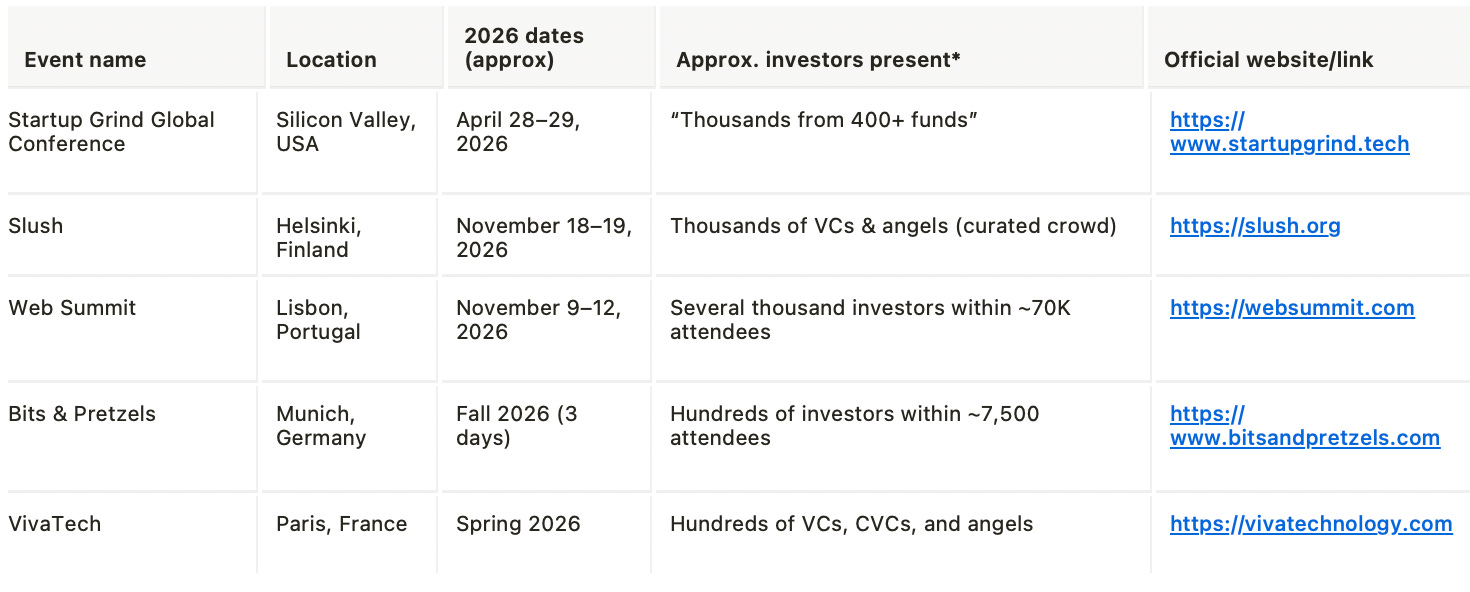
* Investor counts are approximate ranges inferred from organizer descriptions and attendee numbers, not hard caps.
Other notable “deal room” conferences
Lists from StartupBlink, Vestbee, and other founder‑focused meetups repeatedly highlight a small set of events as especially strong for meeting both founders and investors: VivaTech in Paris; SaaStock in Dublin; SXSW and SaaStr in the US; and regional events like Arctic15 and London Tech Week that emphasize structured matchmaking. Each has its own flavor, but they all pitch the same core value: concentrated time with people who can write checks, sign pilot deals, or join your team.