
The Messy, Inspiring Reality of Real-World Robots
What China’s Humanoid Robot Games Reveal About Our AI Future

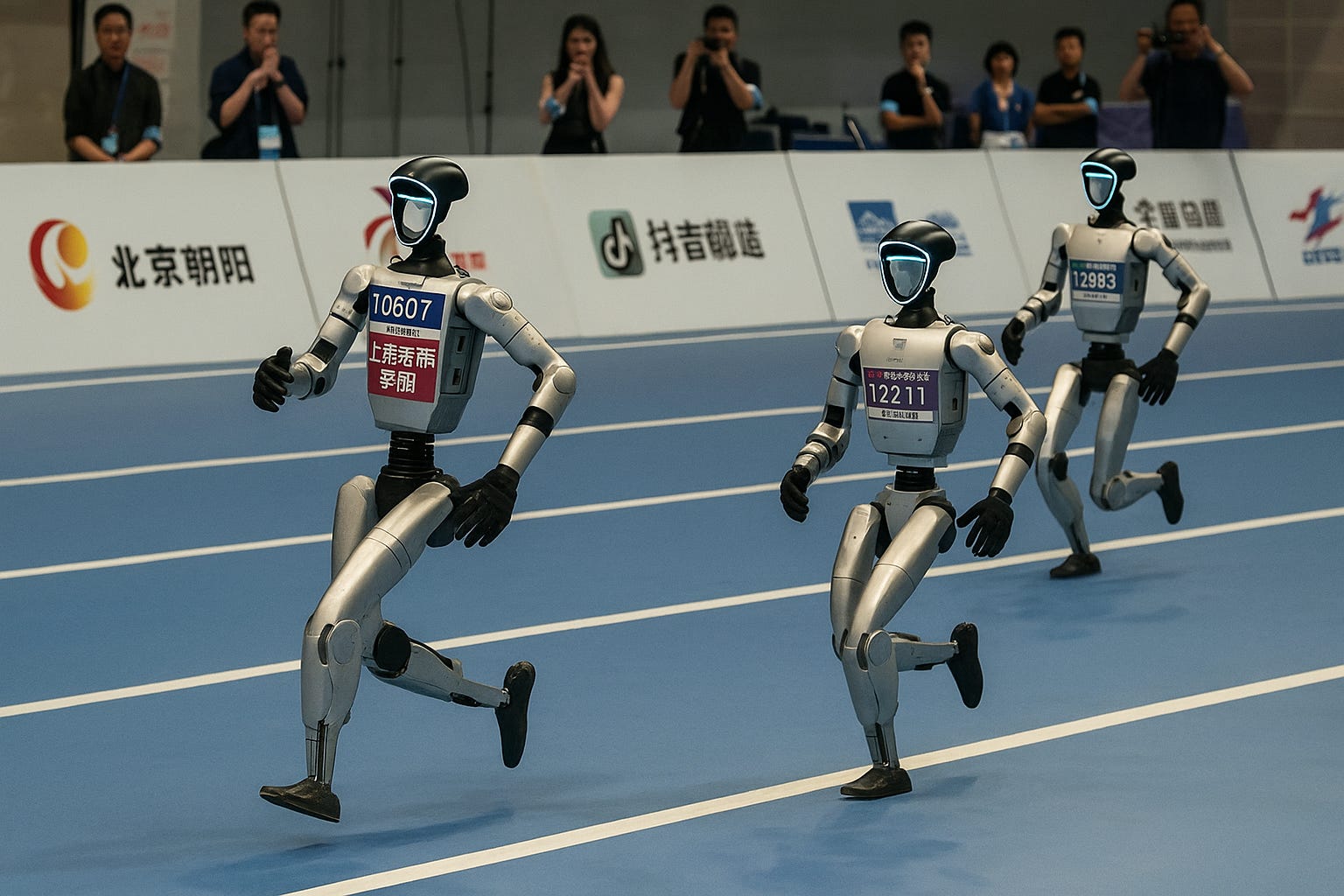
China’s World Humanoid Robot Games this August unfolded like something straight from a sci-fi fever dream, and as a founder and sports fanatic, I was intrigued by every messy, fascinating element of it.
Picture the scene: Beijing’s stadium packed with hundreds of humanoid robots representing 16 countries. Their mission? To run, box, and even compete in table tennis. Energy buzzed with possibility, but not every robot lived up to the hype. In one race, a competitor’s head spun off mid-stride, while another spiraled out of control on the track. Soccer robots collided and toppled. And in the stands, I imagine it felt less like watching futuristic world-class athletes and more like rooting for clumsy toddlers as they stumbled through their tasks.
Yet the ambition behind the event was nothing short of Olympic. China poured $137B into AI and robotics startups, signaling a push to drive global innovation. The country isn’t just funding tech, it’s setting goals to leap from a $378M market in 2024 to over $10B by 2029, and it’s already racing ahead in patent filings against the US, EU, and South Korea. Everywhere you look, from retail stores to marathon tracks, robots are stepping up as athletes, workers, and helpers, ready to be tested in real-world conditions.
But here’s the crucial twist: unlike large language models that train on vast oceans of digital data, robots face a stubborn data shortage. Teaching an algorithm to walk through a crowded restaurant or up a flight of stairs is harder than it sounds; there just aren’t enough real-world recordings to make robot AI robust. China’s push to unleash robots in public spaces may help companies gather more of the physical, messy, unpredictable data that robots need to really learn, but as experts like Dr Kyle Chan, a researcher at Princeton University, and Dr. Jonathan Aitken of the University of Sheffield point out, it’s still the industry’s biggest bottleneck. Aitken is clear: “The state of AI is nowhere near seeing humanoids operating effectively in uncontrolled environments.”
And while watching robots jump or kick might fire up imaginations, it’s handling mundane daily tasks that truly expose the gap. Folding laundry or dicing vegetables requires dexterous hands, a level of mechanical freedom that humans often take for granted. A healthy human hand boasts about 27 degrees of freedom, each one an axis of subtle, independent movement; even Tesla’s highly touted Optimus humanoid manages just 22. Companies, for all their breakthroughs, have yet to crack the code of everyday dexterity.
What struck me most was how the games made tech’s failings public, normal, and even a bit charming. Instead of shrouding setbacks in private labs and hushed boardrooms, teams put their unfinished business on a stadium stage. The crowd didn’t fill every seat, and awkward displays made more than a few tech skeptics shake their heads. Still, being willing to learn in public, to laugh at a robot that faceplants spectacularly, may be the best blueprint for progress in robotics, and for startups everywhere.
The World Humanoid Robot Games proved that billion-dollar funding and global hype can’t shortcut the process; robots, like startups, grow up slow and messy, and data scarcity now stands as the field’s biggest challenge. Public trial, error, and resilience matter more than perfection. In both robotics and entrepreneurship, the winners won’t be those who avoid tumbles, but those who keep experimenting, iterate quickly, and never let a headless sprint end the story.
If you’re building something new, whether a robot athlete or the next SaaS unicorn, maybe it’s time to embrace the weirdness. Every future has its stumbles, and that’s exactly what makes it so compelling.
Failing in public is something we all need to be better at!