
Can Salesforce CRM Reinvent Itself Now That AI Has Arrived and is Changing the Rules?
Every dominant SaaS company eventually will face the same question.

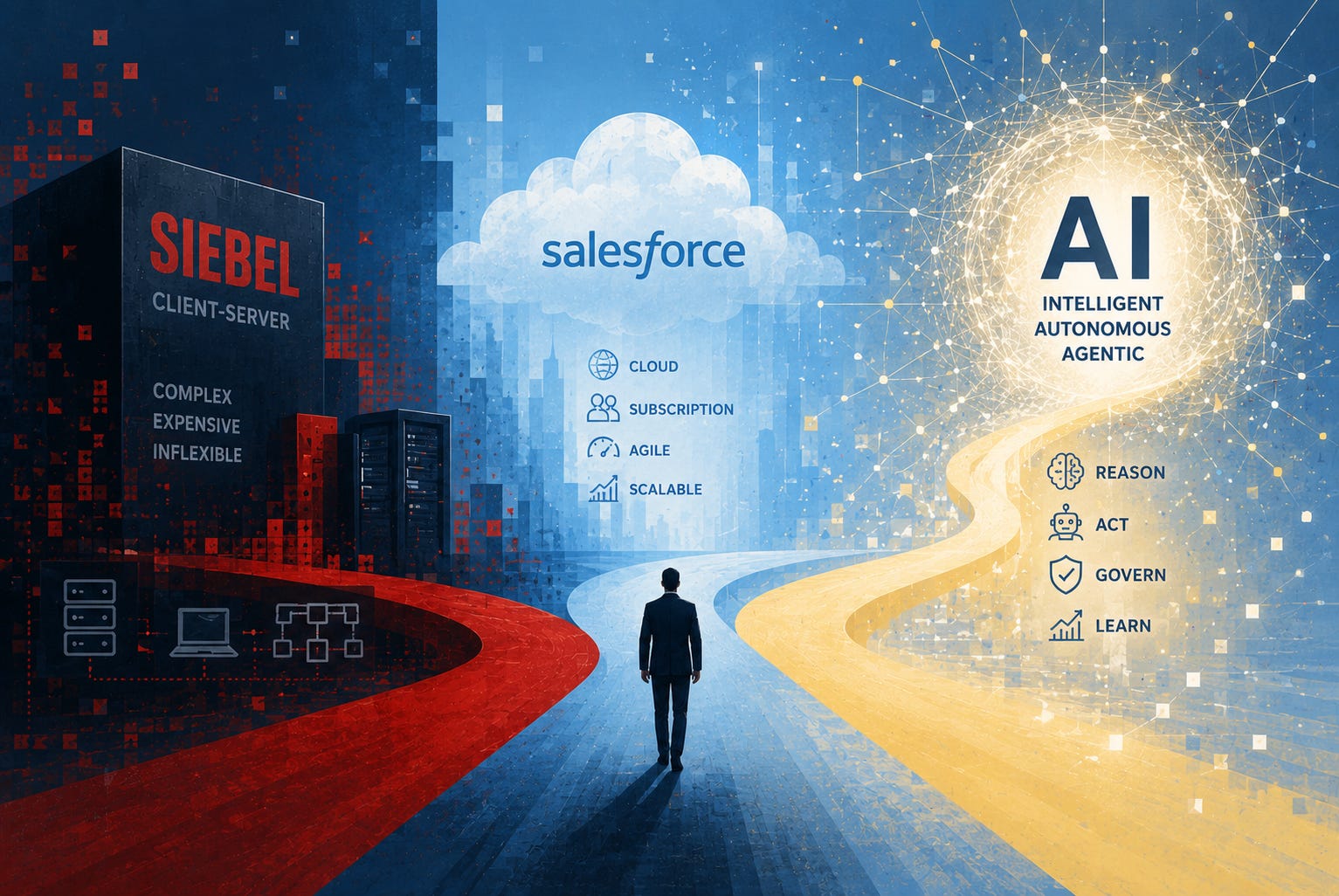
This Debate Sounds Uncomfortably Familiar
Last week, I stumbled across a debate about Salesforce that immediately caught my attention.
One side argued that Salesforce is in trouble. AI agents are changing how software gets built, how work gets done, and how companies interact with their customers. The old SaaS model is under pressure. Today’s CRM systems are becoming less important. The future belongs to AI-native platforms.
The other side argued the opposite. Salesforce isn’t becoming less valuable; it’s becoming more valuable. AI agents need data. They need governance. They need security. They need a trusted system of record. If anything, the rise of AI makes platforms like Salesforce even more important.
As I read through the arguments, I had an odd feeling. Not because one side was obviously right. But, because I’m old enough to remember that I’ve heard this kind of debate before.
30 years ago, in my youth, I was a “player” in the CRM industry as a reseller, consultant, senior product manager, blogger, and eventually as an independent CRM analyst. I even did some consulting work for Salesforce in 2006, before its IPO. Back then, the company at the center of every CRM conversation wasn’t Salesforce. It was Siebel Systems.
If you weren’t around during the client-server era, it’s hard to appreciate how dominant Siebel was. Large enterprises ran on it. Consultants built careers around it. Companies invested millions in implementing it. Industry analysts treated it as the gold standard. It made its founder and CEO, Tom Siebel, a billionaire. If someone had asked who would dominate CRM for the next decade, most people would have answered Siebel without hesitation.
Then cloud computing showed up.
The Moment Salesforce Changed the Rules
Salesforce's famous "No Software" campaign, launched in 2000, positioned the company as the pioneer of cloud computing. It redefined the CRM industry by marketing against expensive, complex, and laborious installations of client-server CRM systems, by offering an easily accessible, subscription-based, web-delivered solution.
Initially, Salesforce’s cloud-based CRM appeared to be, and in many respects was, inferior to the well-established Siebel. It wasn’t as feature-rich, connecting it to legacy systems was difficult at best, and enterprise companies worried about security. Back in those days, most IT executives couldn’t imagine storing customer information outside their own data centers. Most large companies stayed away because the idea of cloud computing seemed risky and unnecessary.
What made the situation interesting was that the arguments in favor of Siebel were completely rational.
Customers had invested enormous amounts of money replacing their mainframes and minicomputers with the client-server hardware that Siebel ran on. Sales teams were trained on it. Business processes depended on it. Replacing it would be expensive, disruptive, and time-consuming.
Everything that IT executives believed was true. Siebel had become the “safe” choice for enterprise CIOs.
But that didn’t stop Salesforce.
Salespeople Saw the Future Before Enterprise CIOs Did
In its early years, what drove Salesforce’s success and rapid growth wasn’t the enterprise market; it was the individual salespeople who hated Siebel, Oracle, and all of the other client-server CRM options that their companies had invested in and were forcing them to use.
What they saw was clunky software that didn’t help them sell, unreliable data synchronization (from their laptops to the corporate servers), and a painful software upgrade process (people had to constantly send their laptops to their corporate headquarters to get updated).
The bottom line was that individual salespeople, small businesses, and sales organizations at mid-sized companies weren’t evaluating CRM using the same criteria as enterprise CIOs were.
Cloud computing and SaaS didn’t start winning because they were a slightly better version of client-server technology. Its initial success was because it solved different problems for different markets. It reduced deployment friction, simplified customization and maintenance, and lowered upfront implementation and training costs.
Over time, those advantages mattered more than the advantages that had made Siebel successful in the first place. As cloud computing continued to evolve and address its limitations, companies that had spent millions on client-server CRM slowly started to migrate to the cloud and Salesforce.
The Question That Matters More To Salesforce’s Future
Eventually, Salesforce didn’t just compete with Siebel. It replaced an entire way of thinking about CRM.
That’s the part of the story that keeps coming back to me whenever people debate Salesforce’s future.
Today, Salesforce occupies the same position Siebel once held. It’s the incumbent. It is the platform deeply embedded inside thousands of organizations. It’s the product with armies of trained users, consultants, administrators, integrations, and partners.
The question is whether AI represents another technology transition on the scale of cloud computing.
If the answer is no, Salesforce will likely continue thriving.
If the answer is yes, history may just repeat itself.
At this point, I’m not placing a bet on Polymarket or Kalshi either way.
Why the Bulls May Be Right
What makes this discussion so interesting is that both sides are making valid points.
The people betting on Salesforce’s future point out that AI needs data.
They aren’t wrong.
A company can’t run thousands of AI agents on top of unreliable information. The more autonomous AI becomes, the more important governance, permissions, security, audit trails, and data quality will become. An AI system that makes one bad decision is a nuisance. An AI system that makes hundreds of bad decisions before anyone notices can become a catastrophe.
That reality strengthens the case for systems of record.
Aaron Levie, CEO at Box, recently argued that we’re moving toward a world with dramatically more AI agents than human users. If that’s true, somebody still needs to control what those agents can see, what actions they can take, and how their work fits into broader business processes. From that perspective, Salesforce doesn’t disappear. It becomes infrastructure.
It’s a compelling argument.
Why the Bears May Be Right
The people on the other side are making an equally compelling case.
Historically, CRM systems were built around human users. Salespeople entered contacts, sales opportunities, and notes. Service representatives logged interactions. Managers reviewed dashboards and reports. The entire system assumed that people were responsible for capturing, organizing, retrieving, and analyzing information.
AI changes that assumption.
What happens when software automatically captures conversations, updates records, summarizes meetings, qualifies leads, drafts responses, coordinates workflows, and recommends next actions?
What happens when users no longer spend most of their day clicking through CRM screens?
What happens when the interface itself becomes less important?
Those questions matter because Salesforce’s business model was built during a period when human users were at the center of the workflow.
The rise of AI agents could move the center elsewhere.
The Real Issue Isn't Just AI. It's the Different “Jobs To Be Done” and Desired Outcomes That Result From It.
This is why I think many people are framing the debate incorrectly.
The question isn’t whether Salesforce can add AI.
Of course it can.
The question isn’t whether Salesforce can launch AI products.
It already has.
The real question is whether Salesforce can replace the 20-year-old outcomes that are achievable using its current solution with today’s desired AI-centric outcomes.
That’s a much harder question to answer.
Most Companies Don't Miss the Future. They Resist It
History suggests that technology leaders rarely lose because they fail to recognize change. Most see it coming. Kodak understood digital photography. Blockbuster understood streaming. BlackBerry understood smartphones. The problem is usually not awareness.
The problem is transformation.
A company spends years optimizing itself for one world, then the world changes.
The very strengths that once created success become sources of resistance.
That’s why some companies stumble.
It’s also why Microsoft’s story is so remarkable.
There was a period when many people thought Microsoft would become irrelevant. The company appeared tied to desktop computing while the world moved toward the cloud. Instead of defending the past, Microsoft reinvented itself. Azure became a core growth engine. Office evolved into a subscription platform.
Microsoft survived because it was willing to disrupt parts of its own business before the market forced it to.
That’s the challenge facing every dominant SaaS company today, including Salesforce.
The Comparison I Can't Ignore
Personally, I find myself leaning toward the view that Salesforce eventually follows a path more similar to Siebel than Microsoft.
Not because Salesforce is poorly managed, its products are weak, or AI will make CRM disappear overnight.
I lean that way because we’ve entered a new computing era.
Products designed for one era rarely remain dominant in the next.
The future market leaders are often built around assumptions that seem less important today but become obvious in hindsight.
Back in the late 1990s, very few people would have predicted that a cloud-native startup would eventually replace the dominant client-server CRM company of the day.
Today, it feels equally difficult to imagine a world where Salesforce is no longer at the center of customer management.
Which is exactly why the comparison interests me.
The Future Always Sounds Unreasonable at First
The strongest signal that a technology transition is underway is when the future still sounds unreasonable.
Maybe Salesforce will successfully reinvent itself and become the foundation layer that powers millions of AI agents. Or, maybe it builds an entirely new CRM solution for the AI era.
If not, we may be witnessing the early stages of the same story that played out when cloud computing challenged client-server software.
What Founders Should Take Away From This
I don’t know which outcome will win.
What I do know is that SaaS founders should pay close attention.
Every startup is built on assumptions about how to help its customers achieve their desired outcomes, and every successful company eventually becomes optimized around achieving those outcomes.
The danger begins when founders start defending yesterday’s assumptions instead of questioning whether they still matter.
Over time, technology changes. Customer behavior changes. Markets change.
We’ve entered a different computing era. Most of the products created for the previous era will be replaced by new ones tailored for AI.
The companies that survive will be the ones that willingly rethink how they can best serve today’s customers by doing what’s necessary to take advantage of the latest industry and technology trends.
In the case of CRM and SaaS in general, it’s time for their leaders to rethink how their solutions help to achieve “todays” AI-era desired outcomes, before they are forced to do so by the market. Or they just may face their demise.
History doesn’t always repeat itself. But smart founders react boldly when there’s a chance that it might.
Writing this post reminded me of when MTV first came on the air in 1981, and changed the music industry forever. The very first video played was “Video Killed the Radio Star.”
The Buggles very cleverly sang in their technology-enlightened lyrics:
“We Can’t Rewind, We’ve Gone Too Far.”
Stupid piece of trivia. The keyboardist in the Buggles is Hans Zimmer