
AI is Making Bootstrapping More Viable
With falling development costs and revenue often arriving earlier, some founders have more time before they need to ask anyone for money.

Article Summary
AI isn’t making the startup process easier. But it is changing the speed of the process, and for many, the capital required to succeed.
For years, founders believed they needed outside capital before they could build anything meaningful. They needed funds to hire engineers, build a prototype, implement GTM strategies, onboard customers, and provide customer support. Then, after months of spending, they hoped that the market cared and investors would be pleased.
This sequence is undergoing a fundamental change.
With AI, startups can now develop an MVP, learn from and support customers, and grow revenue faster and at a much lower cost. It has created the opportunity for founders to bootstrap until success has been proven before they consider dilution.
The old startup math punished patience
Founders used to face a hard choice early.
Either raise money before you have solid evidence that you’re onto something, or move so slowly that someone else reaches the market first.
That created an awkward scenario. When you pitched to potential investors, you needed to sound certain before you had earned certainty. You needed a big story, a big market, a big team, and a big vision so that you could get people to fund your startup process.
That model still works for companies that need capital before they can generate revenue. But most software founders aren’t building particle accelerators. They’re building a tool, workflow, service, marketplace, data product, automation layer, or niche AI application.
For those types of companies, the question has changed.
It’s no longer, “How do I raise enough to build?”
It’s “How far can I get before I raise?”
That question is creating more bootstrappers.
AI doesn’t lessen a startup’s risk; it’s changed where the risks lie.
AI can lower the risk of pursuing a startup because it reduces the time and money it takes to prove or disprove an idea.
That matters.
Although many developers report productivity gains from AI, they also warned that AI tends to amplify both team strengths and weaknesses.
That last point matters most.
AI helps a founder who already knows the right problem to solve. It helps a founder who can judge quality, talk to customers and ship, test, and revise the product as customer feedback warrants.
It doesn’t save a founder who’s building the wrong thing faster.
The risk has moved from production to judgment.
With AI, you can build the first version of your product with fewer people. But you still have to decide what matters. You still have to know how much customers will pay and be able to spot poor code, weak positioning, shallow differentiation, bad onboarding, and fake traction.
AI lowers the cost of execution. But it raises the value of good decision-making.
The bootstrapper’s advantage is speed to evidence
Bootstrapping used to sound like deprivation.
Now, for many founders, it can be a strategy.
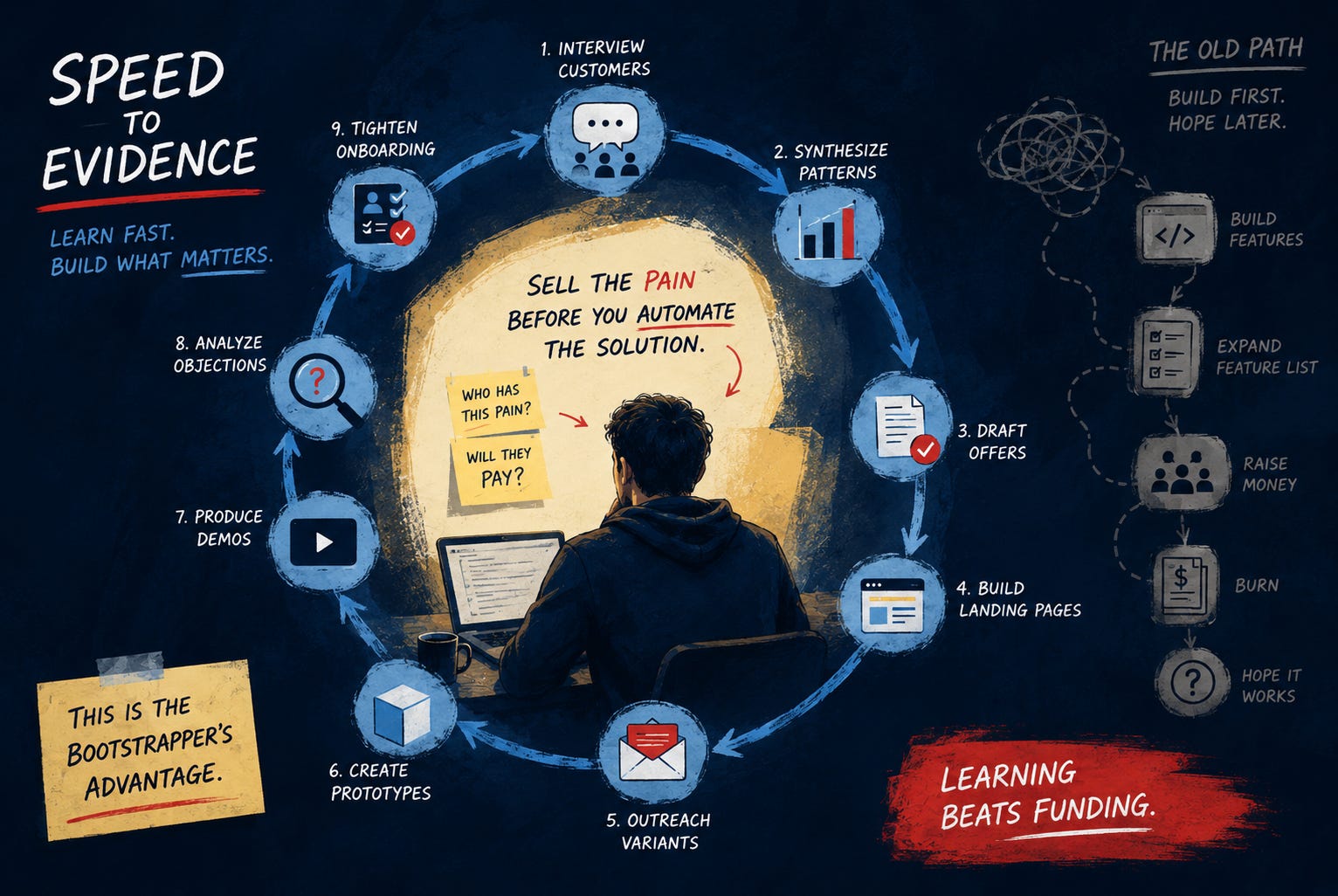
A bootstrapped founder doesn’t need to build the whole company before learning. They can prove the customer’s pain before they automate the solution.
Building an MVP as a first step feels productive because the code changes every day, the feature list expands, and the demo improves.
But customers no longer pay for features. They pay because something costly, annoying, risky, or slow gets better.
This is where AI gives bootstrappers leverage. They can use it to compress the learning loop:
For many founders, interviewing customers, fine-tuning pricing, building landing pages, testing outreach options, creating prototypes or product demos, analyzing objections, and optimizing the onboarding process no longer requires third-party funding. It requires learning.
And when learning gets cheaper, raising too early becomes less attractive.
The founder who reaches revenue has better choices
Capital is not bad. Bad timing is bad.
When you raise before you know what customers want, you’re selling part of the company to finance uncertainty. Sometimes that’s necessary. Often, it’s expensive.
When you generate revenue before seeking capital, the conversation changes.
You’re no longer asking investors to believe you; you’re showing them evidence.
You know who buys, why they buy, what they don’t care about, and how long sales take. You know what happens during onboarding, and most importantly, whether people renew, refer, expand, or disappear.
That evidence gives you options and can lower the cost of capital.
You can keep bootstrapping. You can raise a smaller round. You can use revenue-based financing. You can take angel money on better terms. You can join an accelerator with more leverage. You can say no.
That last option is underrated.
A founder with revenue can choose the right capital instead of chasing available capital.
The real story is not that solopreneurs can now accomplish what used to take a large team to complete in the same, or less time
That story is too simple.
There are one and two-person companies that break the assumption that every company needs a large early team to create a rapidly growing revenue stream.
Pieter Levels became a legend because he built and monetized products with a tiny operating footprint. Base44 is another often talked about example: Maor Shlomo bootstrapped an AI-powered vibe-coding company that grew quickly and was acquired by Wix for about $80 million a mere six months after its founding.
The truth is that small teams can often move faster than large, well-funded organizations because they have less coordination drag. They can test faster because they don’t need board approval. They can survive longer because operating costs are low.
But there is a trade-off. Solopreneurs and small teams have less margin for sloppy thinking.
When you’re a one or two-person company, you don’t have a VP of Sales defining your positioning. You don’t have a product team fixing your roadmap. You don’t have a customer success group to deal with onboarding mistakes. You don’t have a senior engineer quietly preventing every bad technical decision.
AI gives you leverage, but leverage cuts both ways.
A small team with clear judgment can move like a well-funded company. A small team with weak judgment can create a mess faster than ever.
The best bootstrapping strategy is to narrow your ambition
The temptation is to use AI to build something for a large market.
Don’t start there.
Broadly targeted products require broad trust, broad distribution, broad support, and broad positioning. That’s expensive, even when the coding is cheap.
The better strategy is to start painfully narrow; create something for a small market niche.
Pick one customer type. One urgent workflow. One measurable outcome. One buyer with a budget. One wedge where the current alternative is painful enough that someone will pay for relief now.
That doesn’t mean your ambition is small. It means your first proof point is specific.
If you are building a solution for accountants, don’t start with “AI for finance teams.” Start with a painful month-end task that takes six hours every cycle and has a clear owner.
If you’re building for sales teams, don’t start with “AI sales automation.” Start with one repeatable research task that helps reps prepare for a call in five minutes instead of forty.
If you’re building for founders, don’t start with “AI startup assistant.” Start with one job, like turning ten customer interviews into positioning insights, feature priorities, and testable landing page copy.
Narrow wins. Because narrow is easier to sell, easier to build and easier to support.
Bootstrapping rewards precision.
The hidden risk is that your competitors can build faster, too
AI lowers your cost. But it also lowers your competitors’ costs.
That means speed alone is not a competitive moat.
Quickly developing a prototype is no longer impressive. A clean interface is no longer enough. A thin wrapper around an AI model is fragile. A feature that took you three days to build may take someone else three hours to copy.
That’s an uncomfortable truth.
AI creates more bootstrappers because it reduces the cost of getting started. It also creates more competition because everyone else can get started quickly, too.
So your defensibility has to come from somewhere else: from distribution, a trusted audience, proprietary workflow knowledge, deep customer access and understanding, integrations, data customers create inside your product, high product switching costs, a service wrapped around software, or from being the best-known solution for a very specific pain.
But it won’t come from “we use AI.”
That phrase is already overused and meaningless.
The best option is revenue-first
The strongest strategy for many founders is to go for revenue before going for third-party capital.
Build with AI. Keep the team small. Sell early. Charge sooner than what feels comfortable. Use manual processes where automation is premature. Let customers fund the roadmap. Measure what people do, not what they praise.
Then decide whether capital will help.
There are times when raising makes sense. If demand is proven and capital will help you acquire customers faster at a lower cost, consider it. If the market is winner-take-most and speed matters, consider it. If enterprise buyers need security, compliance, support, and integrations that you can’t fund from cash flow, consider it.
You don’t need to turn bootstrapping into a religion.
Raising capital should be a growth decision.
That’s the shift.
AI lets more founders stop asking, “Who can I get to fund this idea?”
And instead ask, “Who will pay for this outcome?”
That’s a better question.
How to proceed now
Start with the smallest paid proof.
Find a painful workflow you understand. Talk to people who live with that pain. Don’t ask whether they like your idea. Ask what they do now, what it costs, where the process breaks, who owns the problem, and what budget exists to solve it.
Then sell an MVP before you build the full product.
Use AI to move faster, but keep yourself in the judgment loop. Let AI draft, summarize, code, test, and analyze. You decide what’s useful, safe, and worth shipping.
Keep your first version narrow enough that a customer can say, “Yes, I need that.”
Charge for it.
A free user can teach you something. A paying customer teaches you more.
Once you have revenue, your funding choices will expand. You can keep compounding quietly. You can raise with evidence. You can hire slowly. You can stay small and profitable. You can build a company that fits your customer, your market, and your life.
AI is not creating more bootstrappers because founders suddenly hate venture capital.
It is creating more bootstrappers because the first expensive mile of company-building has become cheaper.
That doesn’t make the startup process easier.
It gives you more options as to when, and if, third-party funding should be pursued.
Other Related Resources:

Other Related Articles:


